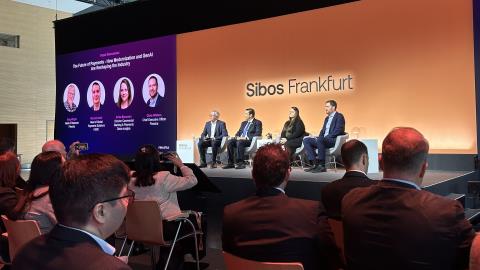
In Frankfurt, managing director Gary Wright facilitated a discussion on how modernization and innovation are transforming the industry.
The panel included Chris Walters from Finastra, representing the technology perspective, Manish Kohli from HSBC, providing insights from banking, and Erika Baumann of Datos Insights, who contributed market research insights.
Baumann provided several key data points highlighting significant investments in payment modernization by banks:
– Up to 50% of banks anticipate double-digit growth in payments.
– Banks are investing over $20 million in payments modernization, reaching an all-time high.
– By Q3 this year, approximately 30% of mid- and large-sized corporate end users utilized AI for cash management and treasury, reflecting a 20-point increase from the previous year.
– 78% of mid- and large corporations are collaborating with fintechs for essential services.
As the industry shifts toward a digital economy, the panel noted the challenges arising from rapidly evolving technology. Baumann described legacy infrastructure as a “black box” that hinders investment plans and outcomes. She emphasized that some corporate end users are advancing their modernization efforts more quickly than their banking partners.
“If businesses invest but banks fail to meet their needs, where will those funds go?” She pointed out that around 78% of mid- and large corporations prefer fintech partnerships for cash management or treasury services, though they’d prefer to stick with their bank if similar offerings were available.
To make a compelling case for modernization, Kohli identified three main factors influencing technology strategy:
1. Understanding customer desires—digitization is key.
2. Addressing regulatory and market infrastructure demands—real-time and API-based solutions are essential.
3. Recognizing that effective enabling technologies must be built on a modern structure.
“The goal is to be modern, not just to modernize,” Kohli remarked. He suggested that organizations should envision what modern infrastructure looks like and ensure their investments align with advancing toward that vision.
Walters stressed the importance of breaking down software into microservices for low-risk transitions. Given the rapid pace of change, he asserted that transformation has become essential. “You need technology that integrates new solutions easily,” he stated.
The panel acknowledged that modernization timelines vary not only by organization size and region but can also differ within the same institution. Walters provided an example: “Only about 10% of our customers are at the forefront of modernization. While it might seem logical to invest less since that’s a minority, we’ve significantly increased our investment to support those leading customers. Their innovations will ultimately benefit everyone else.”
To cut through the noise and prioritize effectively, Kohli emphasized three key principles:
1. Establish a clear strategy for in-house versus partnership developments.
2. Choose technology partners carefully; past successes may not guarantee future success.
3. Progressive businesses should envision the future of money and commerce, acknowledging that strategic bets may sometimes fail.
Baumann concluded by reminding everyone to focus on the core business needs of end users, as that should serve as the guiding principle.